Wednesday, August 6, 2014

Where You Be, Bee?

Landing Board of Top-Bar Hive


This year I decided to try my skills at hiving Carnolian honeybees. Carnolians are not as popular in the US with commercial beekeepers because of their reputation for swarming. Preventing swarms requires a lot of effort and input, which costs commercial beekeepers time and money.

I was primarily interested in keeping Carnolian bees for their mellow temperament and their genetic adaptation to cold. For beekeepers in the Great Lakes region, winter is rough. At least 1/2 of all hives won't make it through to spring. This is why most large-scale beekeepers truck their bees to warmer states during winter.

The first thing I noticed about my Carnolian bees is how productive they are. My top-bar hive was crowded to capacity by July first. I tried to keep ahead of them by removing comb but they swarmed in mid-July. A new queen immediately took over and the colony got back to business foraging and making honey.  


Bee Smoker


Because honeybees prefer a bit of open space in the front of their hive it's best to take out the first wax comb before it reaches full size. I rarely use my smoker (I'm impatient getting it to work) but this time I set my mind to it. I used dry needles from the nearby white pine trees and after nearly half an hour of fiddling around, the smoker produced a pale aromatic plume that quieted the bees while I disturbed their hive. 


Removing the First Bar


Honeycomb on the First Bar


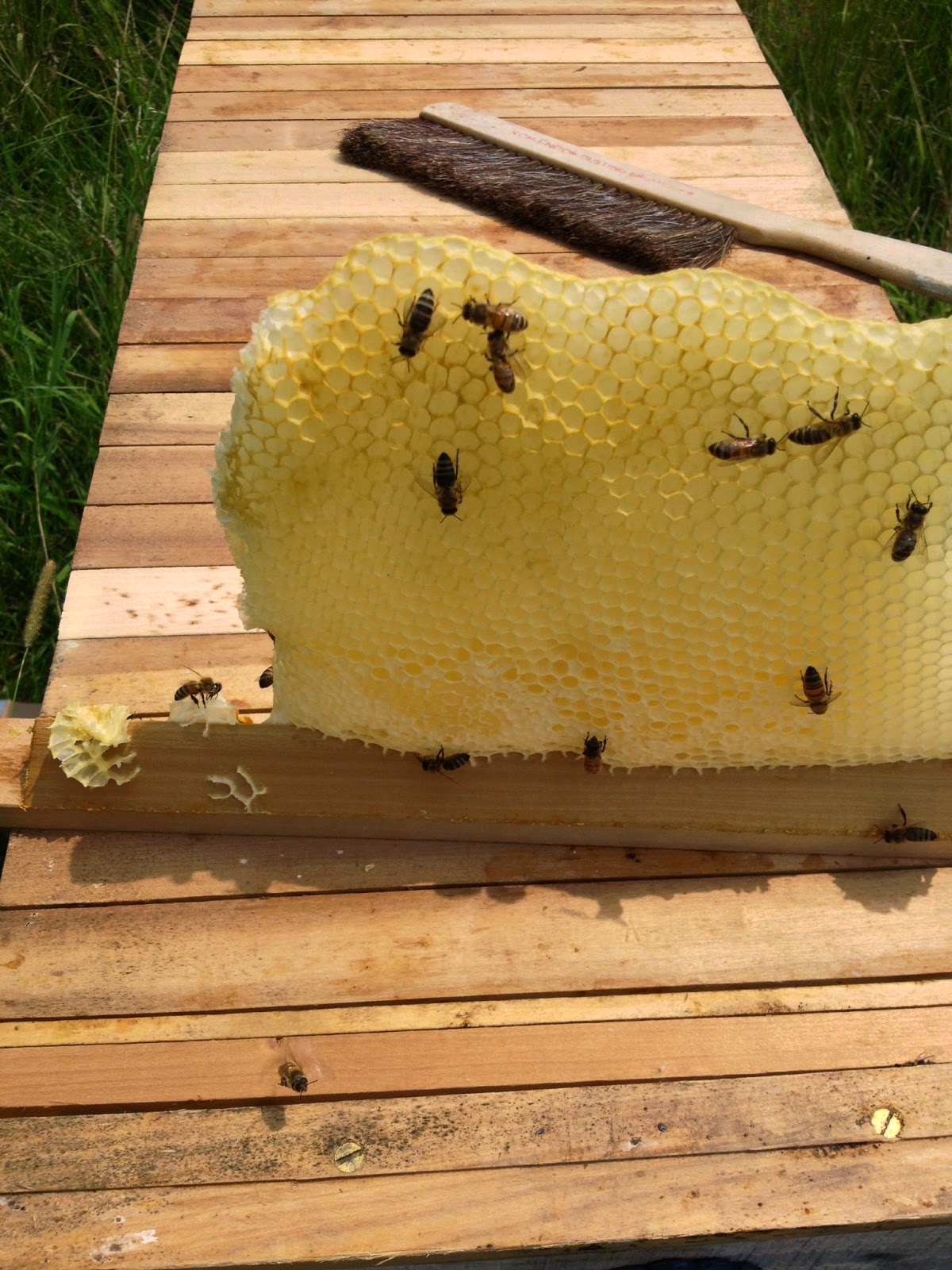
After removing the protective roof from the hive, comb bars are carefully lifted out. Here, the front comb is about 80% complete. Towards the top where it's attached to the bar there is honey, about 1/2 cup, which I kept for myself. Broken bits of comb are returned to the bees for them to recycle.


The Viewing Window


The yellow blob shapes seen above are brace comb. As the wax comb is built to its maximum size and filled with brood and honey, it becomes quite heavy. Honeybees ingeniously engineer lateral brace comb to strengthen it, which prevents the comb from collapsing under its own weight. I use my old art school drafting brush to gently brush the bees aside as I work.  


Beekeeper Selfie!


My hood is hacked with Gorilla Tape because I stupidly ran it through the washing machine. Oops...that's why it's detachable.


Honey from My Bees


Check out my short video to see and hear the wonderful movements and sounds that honeybees make while they work. My Bantam rooster, not to be upstaged, lets loose a mighty crow just after the :30 mark. 


Shane VanOosterhout is The Passionate Gardener.  
For more garden inspiration, you can follow him on Facebook


Friday, December 20, 2013

My Passion for Trees, Part One

"I like trees because they seem more resigned to the way they have to live than other things do."  Willa Cather

Before the leaves were off the branches this fall, I photographed some of the trees and shrubs on my property. I've included labels and some description of each. There are also links to additional sources if you care to learn more detailed information about the specific species I mention in this article.


Northern Catalpa (L); Poplar (R).

(L) Northern Catalpa (Catalpa speciosa). Catalpa has large, heart-shaped leaves and distinctive flowers that resemble orchids. Because of its long, dark seed pods, Catalpa has been commonly referred to as the "Cigar Tree." Catalpa grows rapidly, one foot per year, and reaches a height of 60 feet. You will never see it in a shady spot, nor in soils that are sometimes waterlogged. It's native to much of North America, although it doesn't survive beyond eastern Utah to the west, and isn't found in Florida.

(R) Eastern Cottonwood (Populus deltoides). Cottonwood can reach 80 feet in 20 years' time, but for all the instant gratification, their lifespan is brief. A sugar maple at 40 years is just entering maturity, whereas Cottonwoods are bedraggled old geezers at that age. But their twirling, chattering leaves are wonderful to behold, and there is something remarkable about the speed at which they grow. One of my neighbors planted a thick row of Cottonwoods under his electric lines along the road. Then the power company came by and slashed them to the ground, leaving only stumps. The stumps re-sprouted, and three years later the Cottonwoods are nearly touching the wires again.


Tuliptree.


Tulip Tree (Liriodendron tulipifera) is one of my favorite trees, but I have a lot of favorites. Although Tulip Tree is commonly known as a Yellow Poplar, it is not related to Poplars. In fact, Tulip Tree is a species of Magnolia (Liriodendron is a genus within the Magnolia family). The colonists were rendered speechless at the sight of Appalachian forests filled with majestic Tulip Trees, soaring over 150'. They immediately set to cutting down all the trees to be used for the British navy's ship's masts. Thomas Jefferson planted two Tulip Trees behind Monticello, his estate in Vermont. I own a couple of vases that were turned from the wood of these trees when they were felled not too long ago.


Red Oak (L); Black Willow (R)

(L) Red Oak (Quercus rubrum) adapts to loam, sand, and clay soils; pH from 4.3 (acidic) to 7.3 (alkaline). If you study my photo you'll notice two things in the background: cattails and a tall Black Willow, two obvious signs of wetter soil. This Red Oak is planted in a transitional plane where the soil is sometimes damp, sometimes dry, and the pH leans toward alkaline. Allowed to grow in an open field, Red Oak can reach grand proportions--50' high by 50' wide. Some day, this tree will provide valuable food for local wildlife--acorns rich in fat and carbohydrates. 

(R) Black Willow (Salix nigra) is native to eastern North America. It does not display the ornamental "weeping" growth habit of its Asian cousin (Salix babylonica), but what it lacks in garden appeal, Black Willow makes up for in other ways. It flowers very early in the spring, providing pollen and nectar to bees, and is a host plant to various lovely, native butterflies including Mourning Cloak, Viceroy, Red-spotted Purple, and Tiger Swallowtail. Branches from Black Willow are abundantly useful for weaving baskets and rustic furniture. Its roots thrive in wet soil and help prevent erosion along stream banks.

"To be poor and without trees, is to be the most starved human being in the world. To be poor and have trees, is to be completely rich in ways that money can't buy." Clarissa Pinkola Estes.


Japanese Angelica Tree

Japanese Angelica Tree (Aralia elata) is better defined as a large shrub. It's a rather horrible beast (thorny, spreads aggressively) yet has a few strangely charming features, such as its profuse white flower clusters that appear very late in summer. Bees arrive by the hundreds to plunder the flowers' pollen and nectar, filling the air with musical buzzing. Once the flowers have been fertilized, they quickly produce dark purple berries that last only a few days until the birds devour every last one. Unfortunately, Angelica Tree is non-native, and can be invasive in the north-east U.S. Therefore I recommend planting its native cousin, Devil's Walking Stick (Aralia spinosa) if you (as I do) have a fondness for menacing plants.


Shagbark Hickory

Shagbark Hickory (Carya ovata) produces both male and female flowers on the same tree (moneocious). Shagbark is related to walnuts, and similarly produces a large green fruit that squirrels find irresistible. The bark becomes "shaggy" as the tree ages, as if peeling away from the trunk. Although slow growing, Shagbark Hickory eventually reaches 100 feet in optimum growing conditions. On my property, I'm clearing out the nearby weakling Ashes and Elms so that this Shagbark can grow a fuller canopy.

"In nature, nothing is perfect and everything is perfect. Trees can be contorted, bent in weird ways, and they're still beautiful."  
Alice Walker


Maple 'Red Sunset'


Red Maple (Acer rubrum) is far and away one of the most popular (and planted) landscape trees in the U.S. It grows in about 85% of the lower states. Horticulturists have produced a number of cultivated varieties that are sold in nurseries. 'Red Sunset' is favored for its symmetrical growth habit and intense fall color. Admittedly, I was in a hurry to get a decent-sized tree on this spot, so I purchased this clone. Closer to the edge of the woods, I've planted a dozen or more wild (uncultivated) Red Maples to increase genetic diversity. Eventually they'll begin throwing off hoards of seed pods, and I'll have wild volunteers. 


I'll be back soon with more trees...and shrubs!


Shane VanOosterhout is The Passionate Gardener.  
For more garden inspiration, you can follow him on Facebook