Showing posts with label honey. Show all posts

Wednesday, August 6, 2014

Where You Be, Bee?

Landing Board of Top-Bar Hive


This year I decided to try my skills at hiving Carnolian honeybees. Carnolians are not as popular in the US with commercial beekeepers because of their reputation for swarming. Preventing swarms requires a lot of effort and input, which costs commercial beekeepers time and money.

I was primarily interested in keeping Carnolian bees for their mellow temperament and their genetic adaptation to cold. For beekeepers in the Great Lakes region, winter is rough. At least 1/2 of all hives won't make it through to spring. This is why most large-scale beekeepers truck their bees to warmer states during winter.

The first thing I noticed about my Carnolian bees is how productive they are. My top-bar hive was crowded to capacity by July first. I tried to keep ahead of them by removing comb but they swarmed in mid-July. A new queen immediately took over and the colony got back to business foraging and making honey.  


Bee Smoker


Because honeybees prefer a bit of open space in the front of their hive it's best to take out the first wax comb before it reaches full size. I rarely use my smoker (I'm impatient getting it to work) but this time I set my mind to it. I used dry needles from the nearby white pine trees and after nearly half an hour of fiddling around, the smoker produced a pale aromatic plume that quieted the bees while I disturbed their hive. 


Removing the First Bar


Honeycomb on the First Bar


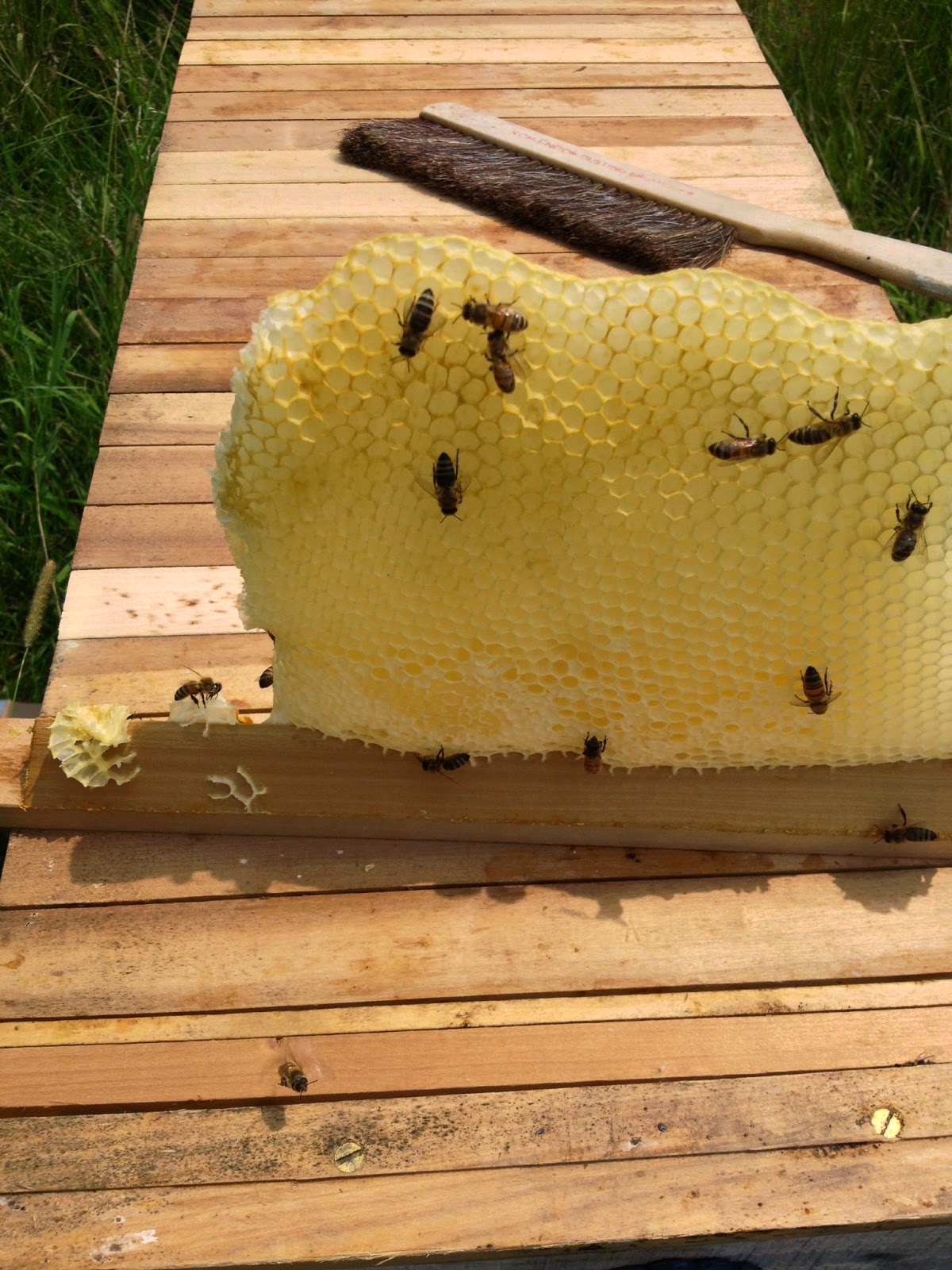
After removing the protective roof from the hive, comb bars are carefully lifted out. Here, the front comb is about 80% complete. Towards the top where it's attached to the bar there is honey, about 1/2 cup, which I kept for myself. Broken bits of comb are returned to the bees for them to recycle.


The Viewing Window


The yellow blob shapes seen above are brace comb. As the wax comb is built to its maximum size and filled with brood and honey, it becomes quite heavy. Honeybees ingeniously engineer lateral brace comb to strengthen it, which prevents the comb from collapsing under its own weight. I use my old art school drafting brush to gently brush the bees aside as I work.  


Beekeeper Selfie!


My hood is hacked with Gorilla Tape because I stupidly ran it through the washing machine. Oops...that's why it's detachable.


Honey from My Bees


Check out my short video to see and hear the wonderful movements and sounds that honeybees make while they work. My Bantam rooster, not to be upstaged, lets loose a mighty crow just after the :30 mark. 


Shane VanOosterhout is The Passionate Gardener.  
For more garden inspiration, you can follow him on Facebook


Saturday, March 3, 2012

All Time Bee Time in the Hive


*Illustration by Fredy Santiago


     A hobby beekeeper is a bit lonely during the winter.  He sometimes sulks and worries about his bees, and he wakes up shivering on a blustery night fearing that his bees will freeze to death when the temperature dips below 32 F.  He routinely visits his hive every day, although there is nothing to see because bees don't fly when it's cold.  He asks his chickens, who live alongside the hive, if they know anything.  They do not.  They only want grapes.  
     Sometimes the beekeeper gently taps on the side of his hive and shyly inquires, "Hello?"  But he is only disappointed by the lack of response, and he wistfully remembers the good times: last summer, when his bees never failed to greet him.
     So what exactly do domesticated honeybees do to pass the time during the cold season?  Play checkers?  Tell ghost stories? Take up knitting?
     A for-profit beekeeper tends hundreds or even thousands of hives and ships them someplace warm during the winter, such as Florida, where he leases his bees to citrus and nut farmers for crop pollination.  (Sadly, it's not in a bees' contract to receive paid vacations, so there will be no side trips to Disneyworld to see famous animatronic bees reading the Gettysburg Address.)
     However, a picayune apiarist has no need to truck a single hive down south, so he is hanging tough with what's left of his hive after the Great Swarm of 2011. 
     Honeybees stay warm in winter by clustering together in the middle of the hive at the top of the comb, contracting their chest muscles (they have no Pilates instructors in the colony) which keeps the center of the cluster at a constant 93 F. 
     Inside the cluster the workers all point their heads facing inward. The queen of course luxuriates at the balmy nucleus of this big bee snuggle, pampered by her devoted workers.  If she needs an extra pair of socks or someone to bring her a mug of honey, she gets it.  The workers continuously rotate their location within the cluster--those in the middle eventually move to the sidelines and vice versa.  The division of labor is surprisingly democratic.

 My Insulated Hive
     When outside temperatures are above freezing, bees can comfortably move about inside the hive.  Below freezing, the bees are immobile, with nothing to do except stare at each other's butts.  In fact they cannot even walk two inches to eat honey.  The longer and colder a winter is, the more a colony is at risk for starvation, especially if they did not have a good supply of pollen and nectar to forage from the previous spring and summer, or if the size of the colony is small.  
     Any amount of additional insulation helps the hive retain heat, thus boosting the colony's survival rate.  In a warmer hive the bees will shiver less and can conveniently access honey reserves without risk of freezing to death. 
     Apis mellifera are meticulously domestic. They don't poop indoors they and they prefer not to have corpses piling up on the living room floor. On a mild windless day, dead bees are dragged to the landing board and then dumped overboard.  This behavior indicates that the colony is alive and organized around their queen.

Bring Out Your Dead
     If all goes well and the bees survives until daytime temperatures are consistently over 50 F., the queen begins laying eggs.  Lucky surviving workers will by now have reached an uncommonly ripe old age of nearly six months (during the busy season a worker may live only 60 days) and without complaint these old ladies begins to raise brood and nurse them to adulthood. This will be the beginning of the success of the colony for another summer.  Only then will the anxious beekeeper breathe a sigh of relief.
     

A Worker Laid to Rest


*A special thanks to the very talented artist Fredy Santiago for creating the queen bee illustration specially for this post.  I love Fredy's drawings for their clever humor and incredible use of line and color. He is for hire!  Be sure to check out Fredy's ultra cool websitewww.imsugarcoated.com


Shane VanOosterhout is The Passionate Gardener.  
For more garden inspiration, you can follow him on Facebook


312718_10% of $100 Order+ at Jackson & Perkins

Tuesday, October 4, 2011

September Swarm

Photo by Shane VanOosterhout

   On September eleven my honeybees swarmed.  I got the news from my father who casually mentioned something about seeing a "bee house in the trees."  Vaguely worded, but I know how to decipher.
     "Which trees?"  I asked, a sick feeling in my gut.
     "The pines."
     "Which pines?  We have lots of them."
     "By the chicken pen."
      I walked outside to discover a few thousand bees settling on a pine bough eight feet off the ground.  I felt dishonored -- they could have at least waited until next spring to pioneer.  After all, I had given them a deluxe home, hand built from cedar, covered by a pitched copper roof. 
     People say honeybees swarm when their hive is crowded. My hive was half full.  As I lamented the hubris of my bees I recited from memory an old nursery rhyme: 


A swarm of bees in May
Is worth a load of hay;
A swarm of bees in June
Is worth a silver spoon;
A swarm of bees in July
Is not worth a fly.
*A swarm of bees in September
Will be dead by December.

*Last two lines author's addition

    I photographed the swarm, then consulted my library of beekeeping materials.  Could I intervene and save these feckless bees from their suicide mission? 
     Fortunately, swarms typically linger in one spot for several days while scout bees check out the real estate. The next morning the swarm remained intact, swaying gently like an enormous flower bud on the end of its stem.  
     I severed the pine branch and dumped the cluster of bees into a tall plastic container.  After knocking off the last bees I laid the branch across the top of the container and closed the lid, leaving a half inch space for the bees to come and go while collecting pollen and nectar. They buzzed in baritone.  Some of the guard bees flew in defensive loops around my head and chest as if to say, "I have my eyes on you, fella."
     For seventy-five dollars I purchased a nucleus box made from pine, and two pounds of fresh pollen cake. (If you are wondering, yes I sampled the sticky amber-colored pollen cake -- it tastes subtly of flowers). The bars in the nucleus were treated with pure lemongrass oil, an odor honeybees find irresistible, as do I. 


Photo by Shane VanOosterhout

      When I transferred the bees from the plastic container into the nuc I was amazed to discover a yellow crescent of honeycomb hanging from the branch. Nearly a foot in length and four inches at its peak it had been fabricated in only five days.  In the warmth of my hand, liquid honey made almost entirely of fresh pine sap and emergency sugar pooled on my fingers, which ended up in my mouth.  Pine flavored honey is an unexpected delight.
      Happily, the original colony seemed to recover nicely from its sudden population decline.  A new queen successfully established -- although I have not yet seen her -- thus keeping the hive from falling into chaos.  Guard bees are actively kicking out the lazy male drones and ruthlessly fighting off mercenary fall yellow jackets that occasionally invade the hive to steal precious honey.
     The nuc is also doing well.  Even after several frosts there is an ample supply of pollen on my property due to my expert gardening and cultivation practices.  A wealth of golden rod, asters and native perennial sunflowers provide the foraging bees enough pollen to take to the nuc, their hind legs stuffed with bright yellow balls of powder, the magical stuff of life.


Friday, August 12, 2011

The Wonders of Beekeeping

Photograph by Shane VanOosterhout 2011
     I was jittery when I began keeping honey bees this spring.  Although I had done my research on the subject over the winter, there is only so much a book can reveal before I have questions that are best answered through hands-on experience, or by more experienced bee keepers who are available on line.
     You Tube is useful for visual demonstrations of just about anything.  The trick is surfing through the crappy videos (most of them) to find a handful of jewels.  It's advisable to find excellent websites and then follow their suggested links as opposed to sifting through another appalling example of what not to do as a beekeeper.  
     On the other hand, perhaps it's not all bad to watch strangers screw up so that you don't have to.  Personally I find it hard to watch a guy inhale from a tobacco pipe and then exhale smoke directly on the swarm.  Nicotine is toxic to bees.  How many dimwits will watch that video and think it's a genius idea?
      When my package of bees was sent from Texas, it was delivered to a tiny town in Marine, Minnesota.  I live in Marne, Michigan.  Totally different zip codes.   After some anxious confusion and haggling, the bees were returned to sender.  The following week I received a new package of bees.  Fully suited, hooded and gloved with kid leather gauntlets, I nervously pried open the screened box and dumped the confused swarm into their new home -- a handsome cedar top-bar hive with a peaked copper roof.  The bees were agitated but immediately settled down just inside the entrance.  I left them alone for a couple of days, checking regularly from a few yards distance.
     It dawned on me that I had forgotten to note the placing of the queen's cage.  Ideally her cage should be placed at the top of the hive where the swarm will keep her warm while the workers free her.  Queen cages arrive with an impregnated queen trapped inside a tiny wooden container that is sealed with a hard candy plug.  It takes at least two days for the workers to eat through the candy and free their new queen. 
     After one week I opened the hive for the first time.  The swarm reacted defensively and many bees landed on my suit and hood.  I was breaking and entering.  Already they had begun construction on a tiny piece of wax comb about the size of a quarter.   I found the queen's cage lying on the floor of the hive, covered with a protective cluster of workers.  
     After gently shooing away the worker bees I was able to pick up the cage and look inside.  There was the frustrated queen, still trapped.  I placed her at the top of the hive where the workers could more easily attend to freeing her.  Still an awkward novice, I crushed about a half dozen bees in the process.  
     I returned to the hive five days later to find the queen still in her cage.  I took a small twig, poked out the remaining twenty-five percent of the candy plug, and set the queen free.  For a minute she lumbered slowly across the floor of the hive, unattended to.  Then, beautifully, some of her workers began to emerge from the swarm at the top of the hive as if they were fashioning themselves into a living rope, an amazing lifeline to sweep the queen from the floor and pull her up into the heart of the suspended cluster, where she has been happily laying brood ever since.