When you visit the new Japanese garden at Frederik Meijer Garden & Sculpture Park, please do not be in a hurry.
Walk slowly along the curving paths. Stop often to observe and reflect. Study shapes and forms. Consider the still pond as a mirror and wonder, why do I assume that that earth and sky are opposites?
Think about scale: What am I compared to a boulder or a Bonsai? In what ways am I larger, smaller or equal to the elements in this landscape?
Think about permanence: The delicate lace of a Japanese maple leaf may be fleeting when compared to an ancient boulder standing behind it, yet how long did it take evolution to bring forth the first seed-bearing plants on earth? Will the boulder always remain a boulder, forever solid and unmoving?
Think about movement: Waterfalls, tree branches, foliage, breeze, ripples, animals and insects, the beating of your heart.
Think about stillness: Wood, stone, water, a turtle, the voices in your head. Become aware of your breath.
Think about time: Spring, Summer, Fall, Winter. The moment you are living in, today, tomorrow, next year, 100 years from now, 5000 years before you were born.
Feel: Feel the different textures, the liquids and solids, the warm and the cool. Now, feel what your senses feel without the words your mind searches to give them.
Walk slowly along the curving paths. Stop often to observe and reflect. Study shapes and forms. Consider the still pond as a mirror and wonder, why do I assume that that earth and sky are opposites?
Think about scale: What am I compared to a boulder or a Bonsai? In what ways am I larger, smaller or equal to the elements in this landscape?
 |
| Dylan scales a boulder. What does he seek...? |
Think about permanence: The delicate lace of a Japanese maple leaf may be fleeting when compared to an ancient boulder standing behind it, yet how long did it take evolution to bring forth the first seed-bearing plants on earth? Will the boulder always remain a boulder, forever solid and unmoving?
Think about movement: Waterfalls, tree branches, foliage, breeze, ripples, animals and insects, the beating of your heart.
Think about stillness: Wood, stone, water, a turtle, the voices in your head. Become aware of your breath.
Think about time: Spring, Summer, Fall, Winter. The moment you are living in, today, tomorrow, next year, 100 years from now, 5000 years before you were born.
Feel: Feel the different textures, the liquids and solids, the warm and the cool. Now, feel what your senses feel without the words your mind searches to give them.

Haiku poems are inscribed throughout the garden.
 |
| Young trees planted along the jetty will one day cast big reflections. |
 |
| A single pine will be gradually shaped and pruned to traditional form. |
 |
| Stone paths direct you to quiet places. |
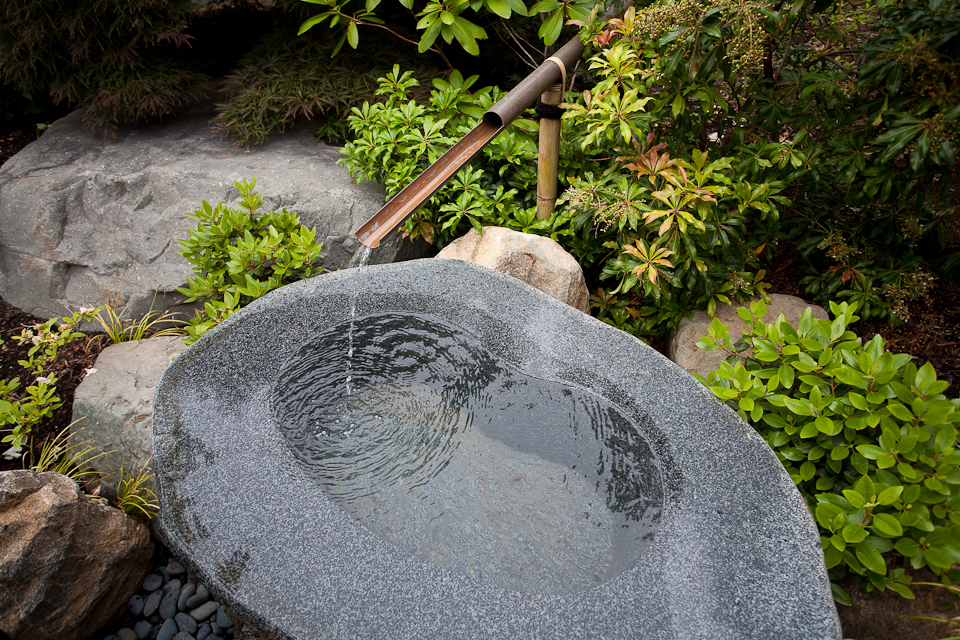 |
| Water trickles so softly it barely disturbs the surface. |
 |
| A tiny leaf beautifully contrasts the dark and gentle ripples. |
 |
| Curving waterfalls seem to appear and then vanish. |
 |
| Be sure to observe this sculpture from its opposite side. The differences are telling. Artist: Anish Kapoor. |
 |
| Mineral formations in the rock look just like...clouds? A river? |
 |
| Bonsai collection, displayed honorably. |
 |
| The roots of any good Bonsai deserve a close look. |
 |
| Asymmetry stirs the mind, does it not? |
 |
| If you only seek answers, you will forget the purpose of asking questions. |
 |
| Don't you want to sit there and let the time pass? I do! |
 |
| There is no need to hurry down these steps. |
 |
| From a great height, everything changes. |
 |
| Everything that needs to be, is. |
 |
| The mighty Lotus rises above the water. |
 |
| I love the way this Buddha seems to be melting into (or growing out of?) the earth. Look how happy and calm he is. Artist: Zhang Huan. |
 |
| These three mysterious forms...are nothing short of mystical. |
 |
| Rectangular forms irregularly placed. How do they impact your perception? |
 |
| I used a fast shutter speed to freeze the water droplets. Modern technology reveals hidden secrets unavailable to 17th Century Japan. |
 |
| The circle symbolizes infinity. |
 |
| Susan meditates, soulfully of course. |
 |
| You can't have a Japanese garden without Wisteria. In ten years from now it will be a showstopper. |
 |
| Small stones tied like gifts indicate areas that are still off limits. |
 |
| Of course, there is sculpture! Is the trunk holding the hand, or is the hand holding the trunk? Artist: Giuseppe Penone. |
Follow The Passionate Gardener on Facebook.


